
Off-site construction: the advantages of Neolife bio-based cladding
News — 19/02/2026 — By Neolife
What exactly is off-site construction?
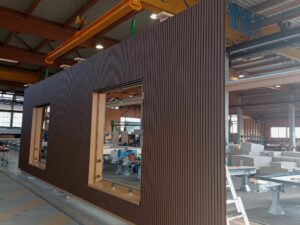
Off-site construction involves manufacturing the main components of a building (walls, floors, complete modules) in a factory before assembling them on site. This construction method relies on management tools that make it possible to anticipate each stage, plan interventions and coordinate all trades within a single production site. Where traditional construction sites can be subject to weather conditions, schedule disruptions or compartmentalised organisation, off-site prefabrication adopts a more fluid industrial approach, with processes under constant quality control, to achieve zero defects.
In short: off-site construction enables mass production and cost control, while improving reliability, precision and overall efficiency.
According to a study conducted by the FFB, off-site projects can reduce construction costs by up to 30%, particularly through the optimisation of resources used and better management of construction time. (Source: Fédération Française du Bâtiment, 2021.)
Off-site: enhanced cooperation between stakeholders
Off-site construction is not just about changing the manufacturing location: it is a new way of designing and managing projects. Project owners, project managers, manufacturers, design offices, installation companies, etc. are involved at an earlier stage and work in a more integrated manner. This upstream cooperation makes it possible to anticipate interfaces, ensure technical feasibility and make deadlines and costs more reliable. Off-site construction thus becomes a real lever for collective performance.
More than just a construction technique, off-site building brings about a real cultural shift: designing differently, cooperating more and manufacturing buildings that are efficient, sustainable and desirable in a more sustainable way.
To learn more >> Read the Off-site Renovation Reference Guide.
Off-site construction: what are the advantages?
The construction sector remains one of the largest emitters of CO₂. However, for several years now, the entire industry has been reinventing itself and accelerating its transition towards more virtuous practices.
And off-site construction is appealing because it offers numerous advantages that are aligned with the current challenges facing the sector:
Much shorter construction times: Prefabrication allows several operations to be carried out simultaneously, reducing the time spent on site. This results in significant time savings, which is particularly useful in projects with tight schedules.
Optimised quality: Working in a workshop offers greater precision, better control over production conditions and repeatability of movements. The result: fewer defects, rework and accidents.
More peaceful and less disruptive construction sites: For both new builds and renovations, particularly on occupied sites, most of the work is carried out in the workshop, which reduces the impact on users and local residents: less noise, nuisance and dust.
A more environmentally friendly approach: Off-site construction limits travel, reduces energy consumption in the workshop, significantly reduces waste and optimises the use of resources. A sober approach that is fully aligned with environmental issues.
Modular and scalable structures: Off-site projects can be designed with a high degree of modularity. Modules can be reversible and designed for a second life, giving the structure a scalable character over time. Partitioning, decompartmentalising, transforming uses… for sustainable building occupancy.
True architectural freedom: Industrialisation and standardisation do not mean uniformity… off-site construction still allows for considerable aesthetic and design freedom.
According to a survey by Le Moniteur, nearly 80% of architects in France plan to incorporate off-site construction into their future projects. (Source: Le Moniteur, survey on the future of off-site construction, 2021).
Off-site construction: for which types of structures?
Off-site prefabricated construction is currently attracting mainly players in the residential segment, but housing is not the only sector that can benefit from this type of industrial technique. In theory, any structure with regular usage patterns can benefit, including:
- schools,
- hotels,
- service residences (students, seniors, etc.),
- clinics.
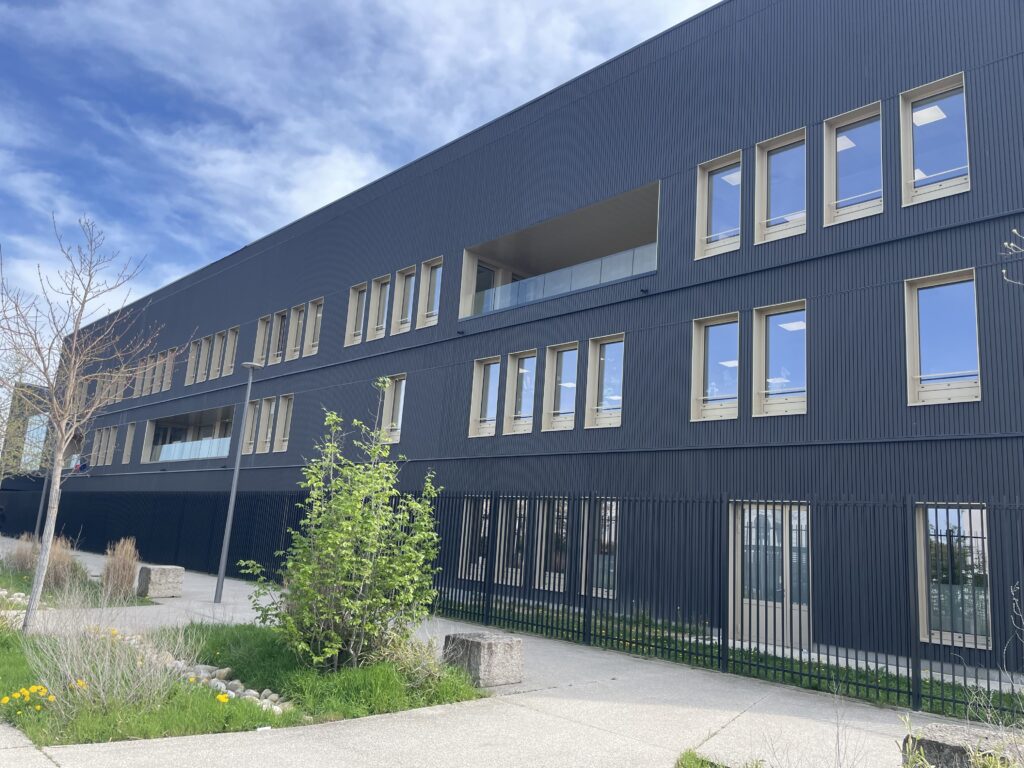
Discover an example: Construction of the Simone Veil Secondary School in Saint-Priest
Prefabrication and off-site construction could account for up to 50% of housing projects in France by 2030. due to increased demand for faster, more environmentally friendly and flexible construction. (Source: Observatoire de l’Habitat, 2023).
Factory prefabrication also meets the immense needs of energy renovation in France, particularly for prefabricated façades commonly used for external thermal insulation (ETI).
Neolife and off-site construction: a long-standing commitment
At Neolife, we are convinced that off-site construction is a concrete response to the major challenges facing the construction industry: climate emergency, need for speed of execution, demand for quality, sustainability and reversibility of uses.
As a designer of bio-based façade solutions, our mission is clear: to devise systems capable of supporting the transformation of our construction methods and to offer innovative products that combine environmental performance, ease of installation and architectural freedom.
As an active member of the Off-Site Campus, we have also been involved in the Energiesprong initiative for many years, which promotes industrial energy renovation. In 2020, we were awarded a prize for the WALLKITE project, recognition of our ability to design reliable technical solutions that are perfectly suited to the requirements of off-site prefabrication >> Read the article.
And we’re not stopping there!
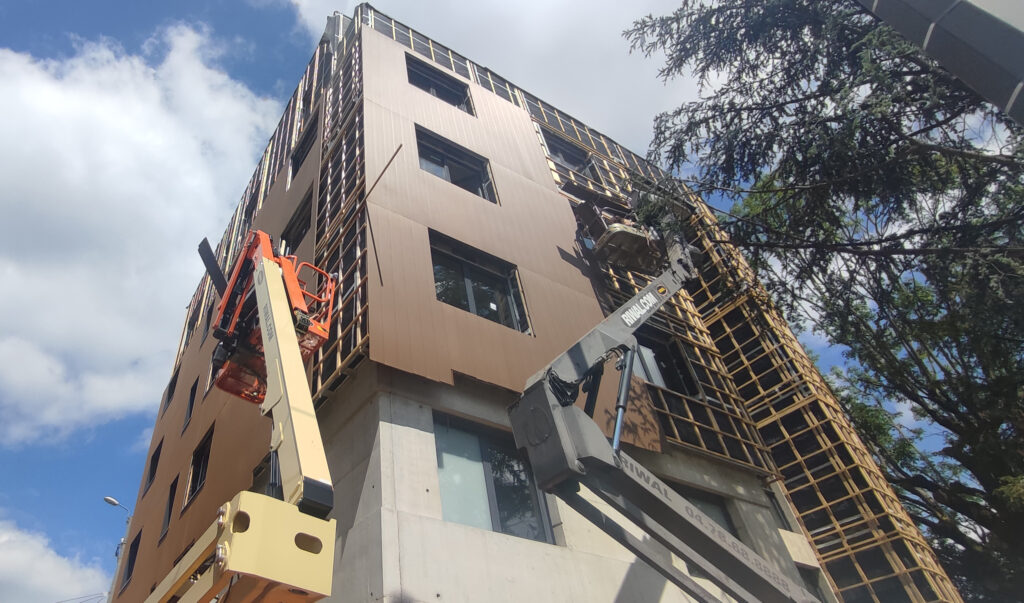
In 2025, Neolife obtained the very first Technical Approval for cladding installed on timber frame façades (FOB compliant with DTU 31.4), offering new solutions to accelerate the development of off-site construction and energy-efficient building renovation.
Low-carbon cladding for off-site construction
Whether for new builds or renovations, our composite wood cladding ranges offer significant advantages for prefabricated façades manufactured in the workshop:
Precision and consistency: our blades are produced with high dimensional consistency, ensuring reliable and consistent prefabricated panels from one module to the next.
Lightweight and flexible: lightweight and easy to handle, our blades are perfectly suited to repetitive movements in the workshop as well as movements involved in lifting and transporting modules.
Quick installation: our boards are easy to install in the workshop thanks to their large width and quick and easy screw fastening.
Eco-designed and 100% recyclable material: our composite wood material is designed in a circular manner from reclaimed wood fibres, without cutting down a single tree. Scraps generated in the workshop can be recycled and reintegrated into the production chain: an approach that is fully compatible with the off-site logic.
Architectural creativity: Textures, finishes, colours… our cladding ranges are designed to unleash architects’ creativity, while complying with the technical constraints of prefabrication.
Discover our LINK range: bio-based false-clapboard cladding, particularly suited to off-site modular prefabrication.